


 About us
 Introduction
 Functions
 Team
Team

Table of contents
Contributors


Layers are important for the scalability of the Blockchain. In this article VBI gives you a deeper analysis of how they work and explains why Blockchain needs so much tiering!
Understanding the characteristics of each layer, helps you better understand this modern technology and have more information for you to make investment decisions.
Layers of Blockchain
If the Blockchain were a house, the background would be Layer 0, the ground would be equivalent to Layer 1, and the roof would be likened to Layer 3.
In which, the must-have part is the Roof (Layer 3) and the background (Layer 0), Layer 2 are additional layers.
Although they have different functions, the layers are still closely connected to help the Blockchain network work better. To understand more about the features of each class, please refer to the details of the article below.
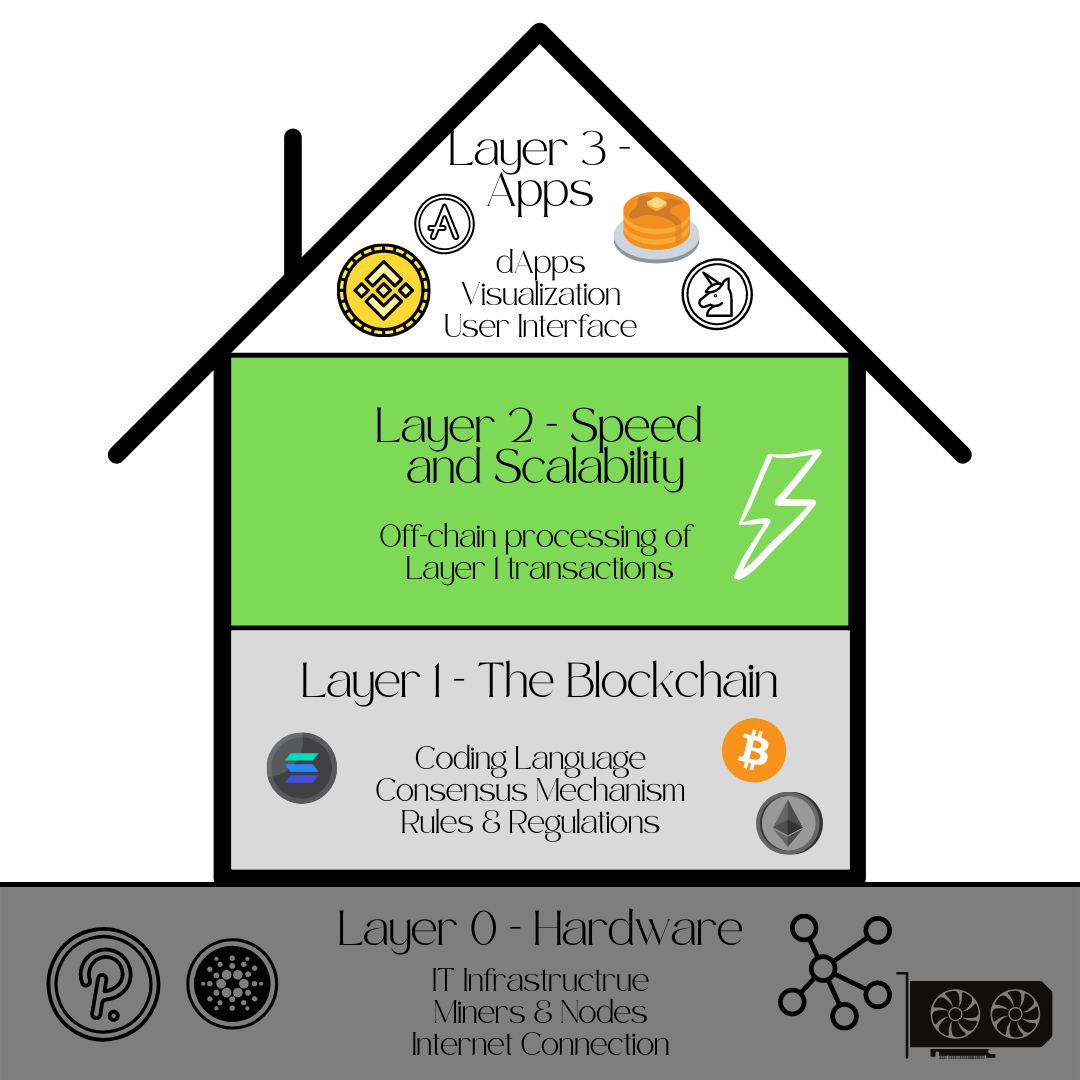
Layers are still closely connected to help the Blockchain network work better | Source: Internet
Layer 0
As the example above, Layer 0 acts as the foundation layer including software and hardware in the Blockchain ecosystem. This layer is considered as the skeleton of the Blockchain, without Layer 0 all activities on the Blockchain cannot take place!
Layer 0 usually uses native tokens, users participating in the network must hoard this native token if they want to exchange and trade. Representing the foundation of Blockchain include Polkadot, Avalanche, Cardano, and Cosmos.
Layer 0 usually uses the native token | Image source: Internet
Layer 1
Layer 1, is understood as the ground floor of the common roof Blockchain, most of the most popular projects today are under L1 for example: Ethereum, Bitcoin, ...
The ground floor is known to be the place to perform basic functions of Blockchain, such as Consensus Mechanism, Block time, etc. Later, when the tasks to be processed on the network increased significantly, Layer 1 often became congested due to the limited throughput of the network.
That's why we need more scalable solutions, which give the system high computing power to solve the problem of processing speed when new blocks are added to the chain.
Although there are a number of methods used to solve the scaling problem such as Proof of Stake and Sharding, in general there is no solution that can completely solve the existing problems on L1. Typical representatives for Layer 1 are: Bitcoin, Ethereum Binance Smart Chain and Solana

The ground floor is known to perform basic functions of Blockchain | Image source: Internet
Layer 2
Layer 2 was created to solve the scalability problems of Layer 1, so far there are four Layer 2 solutions, most commonly used by developers: State channel, Sidechain, Rollup, Nested chain.
State channel: State channels perform the task of updating the state on the blockchain. We can think of it as a separate chain (or channel) that processes transactions. Instead of recording every single transaction, Layer 1 only stores valid information (channel state) from Layer 2.
Sidechain: Sidechains primarily use their own protocols, consensus algorithms, block parameters, and governance to process transactions but still use Layer 1 native Tokens. This means an ETH sidechain. will transact in ETH without the need for other tokens, and any Dapp developed on the sidechain will integrate seamlessly into the Layer 1 network.
Rollup: Rollups take transaction processing off the blockchain and only report the results back to the blockchain. This solution executes the transaction outside of Layer 1, then the data goes to Layer 1 where consensus is reached.
Nested chain: Nested chain (nested blockchain) is basically a blockchain inside, or rather, on top of another blockchain. Nested blockchain architecture typically involves a main blockchain setting parameters for a wider network, while executions are performed on an interconnected web of sub-chains.

Layer 2 was created to solve the scalability problems of Layer 1| Image source: Internet
Layer 3
Simply explained, Layer 3 is understood as a Mobile application, Layer 3 has the main role in providing the user interface and providing utility in the form of internal and inter-chain operability, such as through decentralized exchanges, applications that provide liquidity and staking.
Layer 3 commonly known as decentralized applications (Dapps) provides real-world applications for blockchain technology. Each Dapp usually has completely different roles and functions, for example:
- If we talk about decentralized cryptocurrency trading, we can immediately think of Uniswap and Pancakeswap.
- Referring to providers and centralized exchanges, mention Coinbase and Binance
- When it comes to lending and liquidity, Aave and Compound
- In the payment there will be additional Tornado Cash.
Conclusion
Blockchain infrastructure is still a topic often discussed by developers and technology enthusiasts in the community. Although it has passed the formative stage, in order to maximize the value that Blockchain brings, blockchain technology is still a problem that we still need to take time to research and learn!
Latest posts
Blockchain Knowledge Base
We share common trends, strategies ideas, opinions about Blockchain Technology

Top 5 Blockchain Application Projects in the Healthcare Industry
The application of blockchain in the medical industry has attracted the attention of many people in recent years. It has been used to solve many problems in the medical field, from managing medical data to enhancing patient security and privacy.

Top 4 Blockchain Application Projects in the Hotel Industry
Currently, blockchain is being viewed as an advanced technology that has the potential to improve many areas, including the hotel industry. Some of the applications of blockchain in the hotel industry are as follows: reservation management, customer records management, data management, and expense management. Several blockchain application projects have been implemented in the hotel industry

Top 5 Blockchain Projects Applied in Banking and Finance Industry
Blockchain is a technology that is considered to have great potential to improve safety, transparency, and efficiency in the banking and financial industry. More and more businesses are investing in the development of projects and applications in this field. Some prominent blockchain projects in the banking and finance industry are Ripple (XRP), Stellar (XLM), Corda, and Hyperledger Fabric.